Minnesota is the only state in the U.S. that licenses and regulates the otherwise federally unregulated precious metals industry and Miles Franklin is proud to be fully compliant.
Through our own and third-party tracking technologies, we collect and share with third parties electronic network activity, personal identifiers and information about your communications with us to allow the website to function, prevent fraud, store preferences, analyze usage, personalize experiences, improve services, measure ad performance, and offer targeted advertisements, which may be deemed a sale/share in some states. For more information, you may visit our privacy policy.
By clicking “I Agree”, you are agreeing to the terms of our privacy policy and terms of service.
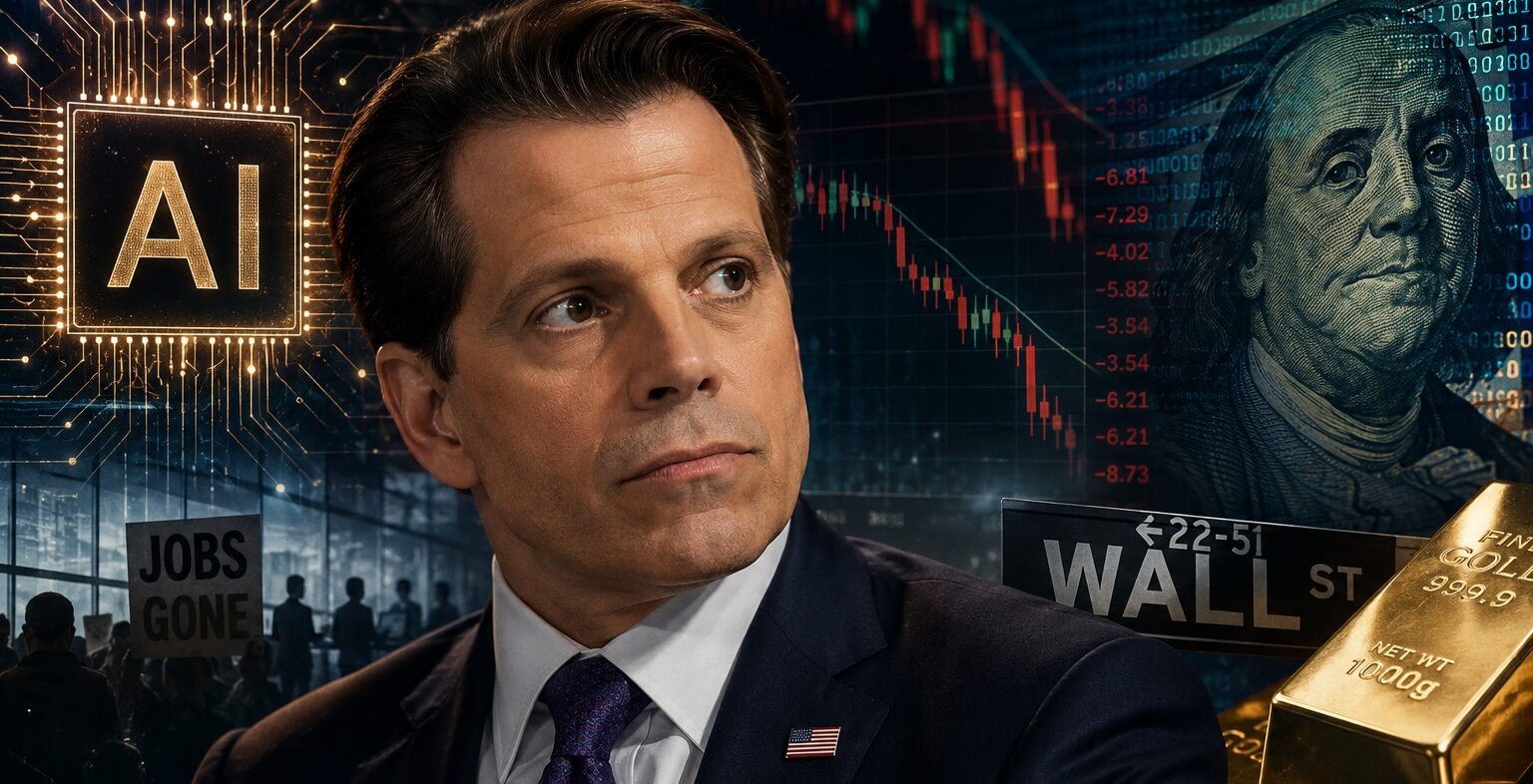
(Miles Franklin Media) – Rapid advances in artificial intelligence could trigger significant disruption across the U.S. economy, with consequences extending beyond markets and into social stability, according to Anthony Scaramucci, founder of SkyBridge Capital and former White House communications director.
“It’s a scary time because we’re talking about displacing 20% of the mid-40, early-50 white collar jobs in the country,” Scaramucci said in the episode of The Real Story with Michelle Makori. “And that’s going to create a lot of economic anxiety and a lot of political tumult.”
Scaramucci said the scale of potential job displacement could accelerate discussions around universal basic income and new forms of taxation tied to AI.
“I think there will be a tax on AI and AI services, and I think there’ll eventually be some form of universal income,” he told Michelle Makori, President & Editor-in-Chief of Miles Franklin Media.
Makori challenged Scaramucci on the broader implications of such policies as universal basic income, particularly when combined with emerging digital financial systems.
She raised concerns that while universal income could help stabilize society during periods of disruption, it may also introduce new forms of centralized control, especially in a world of programmable digital currencies.
Watch the full interview above for Scaramucci’s response to whether UBI could ultimately lead to greater control over the population.
At the same time, Scaramucci acknowledged the broader implications of such policies, particularly when combined with emerging financial technologies.
“There’s a lot to go through right now, and those are all the things we’re going to have to go through,” he said.
From Market Mistakes to Macro Reality
Drawing on decades of experience, Scaramucci reflected on how even seasoned investors can misread systemic risk – pointing to the 2007 financial crisis as a key lesson.
“We thought there was a $90 billion problem. It turned into a $6 trillion problem,” he said, underscoring how quickly localized stress can cascade into a global crisis.
That experience continues to shape his approach to markets today, where he sees both opportunity and fragility.
Advice for Investors and the Next Generation
Despite rising uncertainty, Scaramucci emphasized adaptability and continuous learning as essential skills in the AI era.
“The AI may not replace you, but you know who could replace you is the person that knows how to use the AI,” he said.
He also offered broader life advice rooted in resilience and perspective.
“What other people think about you is none of your business,” he said. “You have to allow yourself to be yourself irrespective of criticism.”
Dollar Strength Defies Expectations
On the macro front, Scaramucci highlighted a counterintuitive trend: the Iran war has been reinforcing, rather than weakening, the U.S. dollar.
“The war has increased the world’s reliance on the US dollar,” he said.
Expectations that geopolitical instability would accelerate a shift away from the dollar have not materialized, he added, with capital flows continuing into U.S. markets.
Gold, Bitcoin, and Asymmetric Opportunities
Scaramucci said he continues to view gold as a long-term store of value, particularly in scenarios where confidence in the dollar weakens.
“I own gold. I believe in gold as a long-term store of value,” he said, adding that in certain macro environments, “gold goes exponential.”
He also pointed to Bitcoin as one of the most misunderstood assets in today’s market, with significant upside potential.
For Scaramucci’s outlook on gold and Bitcoin, watch the video above.
The Biggest Risk Ahead
While Scaramucci outlined multiple structural challenges – from rising debt to political dysfunction – he suggested that the most significant risk to the U.S. economy may not be fully appreciated by markets.
Watch the full interview above for Scaramucci’s take on the biggest risk facing the U.S. economy right now and how it could reshape markets.