Minnesota is the only state in the U.S. that licenses and regulates the otherwise federally unregulated precious metals industry and Miles Franklin is proud to be fully compliant.
Through our own and third-party tracking technologies, we collect and share with third parties electronic network activity, personal identifiers and information about your communications with us to allow the website to function, prevent fraud, store preferences, analyze usage, personalize experiences, improve services, measure ad performance, and offer targeted advertisements, which may be deemed a sale/share in some states. For more information, you may visit our privacy policy.
By clicking “I Agree”, you are agreeing to the terms of our privacy policy and terms of service.
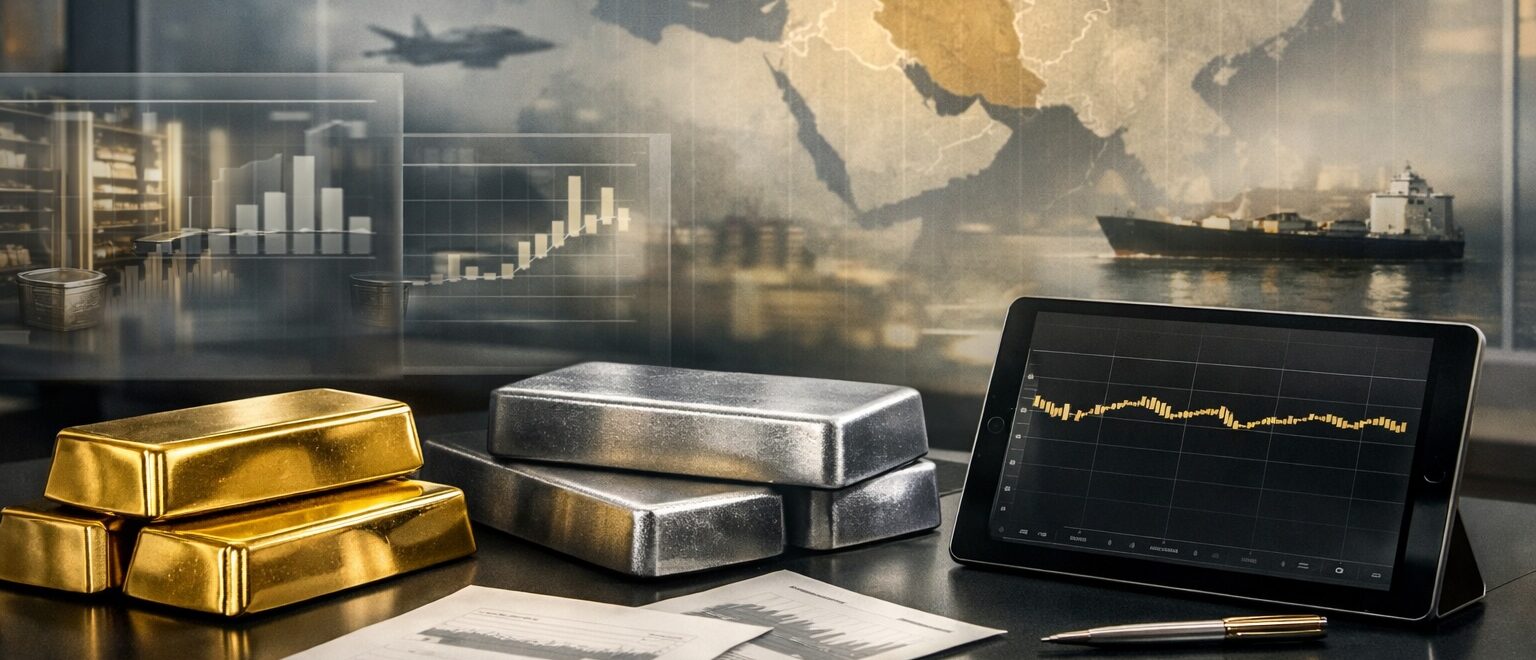
(Miles Franklin Media) – Gold and silver have shown little immediate response to escalating conflict involving Iran, defying a pattern seen in past geopolitical crises and prompting debate over what may be driving precious-metals markets.
Historically, gold has often been seen as a safe-haven asset during periods of geopolitical turmoil. During events such as the 1979 Iranian revolution and the early stages of the Russia-Ukraine conflict, the metal surged as investors sought protection from uncertainty.
In an interview with Michelle Makori, President & Editor-in-Chief of Miles Franklin Media, Andy Schectman, Founder and CEO of Miles Franklin Precious Metals, pointed out that this time around the dynamic in the gold market may reflect deeper market forces.
“Jim Sinclair [a prominent precious metals specialist and gold advocate] used to call it MOPE – management of perception economics,” Schectman said. “It never had made sense to me that when everyone is betting for the market to open much higher because of this conflict, it’s the opposite of that.”
What’s Happening with Gold & Silver
Schectman argued that precious-metals prices may not always react immediately to geopolitical events but can respond later if broader economic consequences develop. “If this war expands, which it appears it is going to expand, it becomes the biggest catalyst for what drives gold the most,” he said, citing uncertainty, loss of confidence and rising debt levels as key drivers.
One factor he highlighted was activity in gold exchange-traded funds. Schectman said large withdrawals from the SPDR Gold Shares ETF, known as GLD, may reflect institutional investors seeking physical bullion rather than abandoning gold exposure.
“We saw $4.2 billion worth of gold leave GLD last week,” he said. “The media interpretation is that nobody wants gold, but I think it’s the opposite of that. Rather it’s someone who wants bars more than they want ETF exposure.”
The structure of the ETF allows large financial institutions known as authorized participants to redeem shares for physical gold in large blocks, typically 100,000 shares at a time. Retail investors cannot redeem ETF shares for bullion.
“When you see that kind of outflow and prices stay stable, the price would collapse if that were the case,” Schectman said. “It’s not an outflow – it’s the redeeming of the shares.”
The discussion also turned to silver, which Schectman said plays an increasingly important role in defense technology and modern military systems. “Silver is needed for defense systems, for aerospace, for communications,” he said. “It’s not optional demand.”
Despite those uses, silver prices have also remained relatively subdued even as governments increase military spending and conflicts escalate.
Schectman pointed to recent movements in the futures market, noting significant physical withdrawals from storage tied to the COMEX exchange. “In the month of February, roughly 25 million ounces were delivered to COMEX, but 38 million ounces left COMEX,” he said. “Thirty-eight million ounces got on trucks and left.”
He said such movements could indicate that sophisticated investors are increasingly seeking physical metal rather than relying on paper contracts. “We are seeing more and more metal leave the COMEX ecosystem,” Schectman said. “Once it does, there is a very labor-intensive and costly process to put it back.”
For more on Schectman’s explanation on gold and silver muted reactions to the Iran war, watch the video above.
U.S. Debt Levels and the Iran War
Beyond metals markets, Schectman addressed the broader macroeconomic implications of the conflict, including government debt and the potential impact of war spending.
He said the U.S. fiscal position remains a key long-term driver for gold. “Washington spends $7 trillion a year, almost double what it spent a decade ago,” according to him. “And now the Congressional Budget Office says the government will spend $7.5 trillion in 2026 and only bring in $5.5 trillion.”
Schectman added that financing wars historically relies on borrowing and currency debasement. “Wars are paid for in one of three ways: taxes, borrowing, or currency debasement,” Schectman said. “They typically will always choose borrowing first and debasement second.”
Schectman also argued that geopolitical tensions could accelerate trends already underway in the global monetary system, including efforts by some countries to reduce reliance on the U.S. dollar. “This is just another leg in the great monetization of the American decline,” he said.
While some analysts argue that a successful military operation could reinforce U.S. geopolitical influence and strengthen the dollar-based financial system, Schectman said he sees little evidence that such an outcome is likely. “I don’t see a positive outcome from this,” he said. “I truly don’t.”
Instead, he said rising government debt and continued monetary expansion could eventually drive precious-metal prices higher. “War is good for gold,” Schectman said. “You’re watching America decline through spending … and that’s good for those people who own assets.”
He added that investors should focus less on short-term price moves and more on preserving purchasing power. “That’s one of the reasons I like gold and silver in your own possession.”